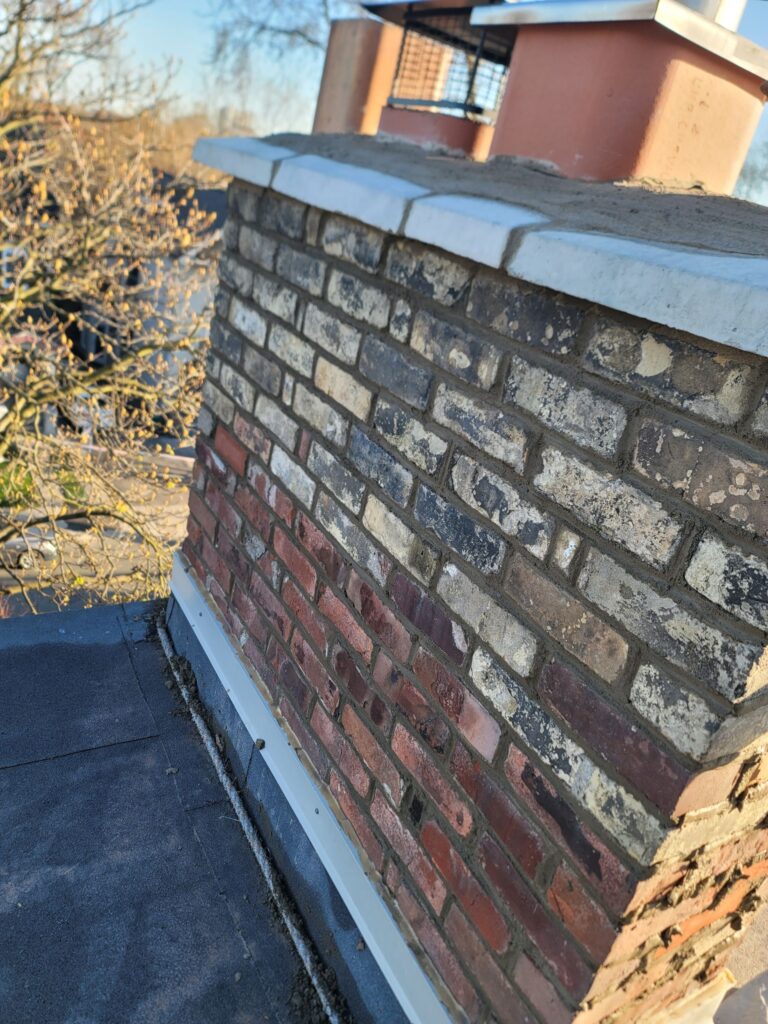
The choice between doing the repair yourself and hiring a professional depends on the extent of the damage and your experience, but with deep cavities and “washed out” joints, as is often the case in Toronto and Mississauga, the scales often tip in favor of a professional. Here is a comparison of both solutions: When can you repair it yourself? Doing the repair yourself (known as grouting or jointing) makes sense if:
The damage is superficial and only occurs in a few places. You have time for very tedious work (cleaning each gap is time-consuming). Aesthetics are of secondary importance (it is difficult to perfectly match the color of the new mortar to the old one).
Why choose a professional? (Key reasons)
Diagnosing the cause A professional will assess whether the joints have been washed out by rain alone, or whether the problem is, for example, moisture rising from the foundations or a leaky gutter. If you do not remove the cause, the new joint will fall out after the first winter.
Choosing the right mortar This is the most common mistake made by amateurs. Using cement mortar that is too hard for old, soft bricks will cause the bricks to crack and “pop” in winter (the weaker material cracks). A professional will select a mortar with the appropriate vapor permeability and hardness (e.g., lime or trass).
Preparing the substrate In order for the new grout to last for years, the old joints must be scraped to a depth of approx. 1.5-2 cm, and the wall must be thoroughly dusted and moistened. Professionals use specialized tools (joint cutters) for this, which do the job precisely without damaging the edges of the bricks.
“Squeezing” technique Professionals often work with mechanical or semi-automatic methods (grouting guns or special bags), which guarantees that the entire joint channel is filled tightly, rather than just “sealing” the hole from the top. This prevents the formation of air pockets where water collects.
Durability and aesthetics A professional will ensure a uniform color across the entire wall and the correct joint profile (e.g., slightly concave), which facilitates the runoff of rainwater instead of allowing it to settle on the bricks. Summary If there are many holes and they are deep, it is better to call a professional. Poorly executed jointing can lead to irreversible damage to the bricks, which in the future will expose you to significantly higher costs of renovating the entire facade.
We provide services in three cities: Mississauga, Oakville, Toronto.